
Cue the Seer
Finding Guidance in the Mystery: Part 2

Dear Fellow Dreamer,
As I was working on a letter to an event organizer, telling them about the main character of my new book, I shared a draft with someone who advised me to remove the word “psychic.” That is, if I wanted my work to be taken seriously.
Perhaps even now, in 2026, that term which derives from the Greek psychikos, meaning “of the mind” and also “soul,” is still too fraught with negative connotations to go unqualified into literary queries. As a fiction writer, my purpose isn’t to appeal exclusively to paranormal enthusiasts or attempt to prove to skeptics that clairvoyance is “real,” but simply to engage readers in a suspenseful character-driven story. One that raises questions about the nature of reality. While I shook my head at the editorial suggestion, intuitively, I knew to follow it. And as usual, I found myself leaning on terms such as “extraordinary perceptual abilities” and “metaphysical fiction,” in order to assuage the potential doubts of gatekeepers.
I ask you…
When it comes to discussions of the afterlife, and of uncanny experiences in this one, do you tend to take a spiritual view? Or are you a strict physicalist? A skeptic? Perhaps you’re someone drawn to explore the mysterious topics of telepathy, remote viewing, prescience, and “seeing beyond the veil”?
Maybe you’re a full-on believer in extrasensory perception and supernormal phenomena. Or a combination of skeptic and want-to-be believer. I think a healthy degree of skepticism is important—to not simply take things at face value, but get to know how you “know” things. The way you know. To track your experiences, including your dreams, and look for patterns.
In that spirit, I admire the work of Harvard scholar, biochemist, and parapsychologist Rupert Sheldrake, whose theory of the “morphic field” and “morphic resonance” suggests that our individual minds are not completely contained by, or limited to, our brains. Sheldrake hypothesizes that the brain acts more like a receiver, tuning in to the collective field of its species. For decades he’s run scientific studies on telepathy. Unsurprisingly, in today’s mainstream academic circles, much of his work is dismissed as pseudoscience. Like others compelled to investigate matters excluded from conventional research environments, Sheldrake is a trail-blazer. He works in the lineage of Frederic W. H. Myers, one of the late 19th-century founders of the UK’s Society for Psychical Research (SPR) and the author of Human Personality and its Survival of Bodily Death (1906). Sheldrake is also a long-time Fellow of the Institute of Noetic Sciences (IONS), conducting research into unexplained phenomena that traditional science often ignores.


Some of us are naturally inclined to explore occurrences that seem empirically unknowable, beyond the realm of “normal,” or both. It’s been a throughline my whole life. As a child, once I’d proven to myself that I could bust my heart open over a novel, E. B. White’s Charlotte’s Web, and I’d graduated to devouring Laura Ingalls Wilder’s tales of 19th-century prairie life, I began borrowing my first library books on reincarnation and extrasensory perception.
When I was nine, we had a babysitter who claimed to be psychic. While my parents were out at the movies, with this kindred spirit I spilled my guts about the secret reading and my intuitions. Mrs. Bloor taught me how to shield a car with light in order to protect it from accidents. Once, on the highway, she said, she’d watched a tire fly off a vehicle ahead of her, bounce off others, and miss her own, because she’d shielded it. She told me children are naturally psychic, but the ability is conditioned out of us. And so, she encouraged me to practise something I was already interested in—reading minds (with permission of course) to determine simple things such as the number another person was thinking of, and tracking my rate of accuracy. She was the best babysitter we ever had.
In the morning, when my mother asked me about the night before, she nodded and smiled, her blue eyes saucering at my account of Mrs. Bloor’s convictions, but she never requested that sitter’s services again. Yet for the rest of my fourth-grade year until she went back to teaching the next fall, during certain lunch hours, between Campbell’s soup and The Flintstones, it was my mother who became my mind-reading practice partner. Each time one of us was accurate, we howled.
Throughout elementary and high school, contemplations of telepathy and otherworldly occurrences hummed along in me with the assigned curriculum. At university, in addition to studying great works of Western literature, I learned about Eastern religions and astral travel. I took a course on the philosophy of mysticism and the paranormal with a professor who introduced me to meditation for peace and invited me to a past-life regression workshop. You could say, for me, he was the Mrs. Bloor of profs. Soon after graduating, when a remarkable dream shook me from my sleep, I sought him out and we went for lunch. From across the table, the professor handed me a picture of Sri Ramana Maharshi and said he saw me working with children.
In Sonya’s Tea Room at the corner of Yonge and Wellesley Streets in Toronto, though I’d wanted to hear of my future life on the stage, turning the cup in his nicotine-stained fingers, Earl the tasseomancer had told me the same thing. Children. Could I have imagined a career in education? Certainly not. My parents were teachers. Who’d want to do that? (Well, I did become a teacher. To this day, on an occasional basis, I still work with young people—sometimes as a substitute, and sometimes as an artist in the school. In addition to coaching adult writers, nurturing youth is work I cherish.)
As promised, in this letter I’ll tell you about one of my favourite memoirs by a self-described clairvoyant. But first, since for many of us it’s time for summer movie nights, here’s a sampling of films on the subject that I’ve enjoyed over the years. Have you watched any of these lately?
In chronological order:
The Eyes of Laura Mars (1978), dir. Irvin Kershner
The Dead Zone (1983), dir. David Cronenberg, based on the novel by Stephen King
Ghost (1990), dir. Jerry Zucker
The Sixth Sense (1999), dir. M. Night Shyamalan
The Gift (2000), dir. Sam Raimi
The Others (2001), dir. Alejandro Amenábar
In addition, here’s one of the best recent films I’ve seen, though the protagonist does not call herself clairvoyant and is unwitting as to the extent of her intuitive abilities:
Nanny (2022), dir. Nikyatu Jusu (Sundance Film Festival Grand Jury Prize Winner, 2022)
And of course, there’s television:
Medium (2005 – 2011), a series created by Glenn Gordon Caron (one my daughter and I watched on many a Friday “girls’ night in” over take-out)
The Gift (2019 – 2021), a Turkish series written by Jason George and Nuran Evren Şit, based on the novel Dünyanın Uyanışı (The World’s Awakening) by Şengül Boybaş
For a more comprehensive list of films with psychic mediums, including some very old ones, see IMDb’s “Fortune Tellers and Psychics in Movies.” I’d love to watch The Clairvoyant (1935), Séance on a Wet Afternoon (1964), From Beyond the Grave (1974), and Murder by Decree (1979)—if only to take in Donald Sutherland as the seer. What about you? Please share your recommendations.
While researching movies about psychics, I came across a documentary that in some ways appeals to me more than the other productions. However, since it’s currently unavailable for streaming in Canada, a Guardian article on director Lana Wilson’s Look into My Eyes, and the movie trailer, will have to do. If you’re interested and able to view this docufilm, please write to me and let me know what you think.
One of the things I’ve appreciated in reading about Look into My Eyes is that its director takes a neutral approach. In the following passage from Adrian Horton’s Guardian feature, “It’s not about proving: inside the mysterious world of psychics,” the quote within the quote is Wilson speaking:
“‘You can come into this film a total skeptic, [or] you can be a diehard believer… This is about how we as human beings try our best to connect with, witness, and heal each other. And how we all need outside witnesses to better understand ourselves.’ Though most of the clients and mediums believe, to an extent, in a spiritual realm and afterlife, the film is first and foremost ‘an exploration of these very human needs we all have that aren’t supernatural at all.’”
As the author of River of Dreams, a ghostly novel about a 1920s mental hospital nurse with unusual perceptual abilities, I find Wilson’s message resonates. And I echo her assertion: “It’s not about proving.” Fiction is, after all, a work of imagination. Some fiction does more than entertain us. It leaves us thinking about issues not only germane to the world of the story, but to our own world. The here and now.
Reflecting on our present time of increasing stimuli, pervasive screens, and attentional challenges causes me to rally behind Wilson’s assertion all the more—that “we all need outside witnesses to better understand ourselves.” In this world of rapid and potentially alienating technological changes, human connection is paramount. Her claim also causes me to cast a loving glance back upon my many encounters with independent healers over the decades—therapists, naturopaths, energy healers, coaches, traditional teachers, shamans, and yes, working intuitives.
From that long-ago first session, a spectral fragment of memory drifts:
Miss Ava in the June heat of a Toronto Bloor Street Annex apartment—in and up through a dim passage to her kitchen table at the back, her piercing eyes. A child playing down the hall. Windchimes clinking. Me at nineteen in a sleeveless rose-coloured blouse, a long Indian skirt and sandals, and a straw hat trimmed with burgundy silk, the scarf a gift from my grandmother. My heart in shreds. But all Miss Ava says is, “There’s a reason you dress the way you do.” The way I want more—for her to say the one I love will come back to me. The way she never gives me that. A comfort? “Go out into the streets in your fine hat. Be a young woman.” Is she telling me to enjoy it? This moment, more fleeting than a little brown bird’s wing flutter. Shoulders back, I step onto the sunlit pavement.
I’m glad I’ve finally written a novel about a young woman. One who dreams.
A Seer’s Memoir
One of the most memorable nonfiction descriptions of a dreamworld experience I’ve ever read comes from Joan Grant’s autobiography, Far Memory. Grant (1907 – 1989), a person with “beyond the usual range of the five senses,” writes of a time in young adulthood when the sudden death of her lover, Esmond, propels her into a deep state of grief. Despite frantic attempts to locate Esmond in her dreams, she can’t. Then does.
“As I gradually became neither avid for sleep nor fearful of not sleeping, I began to dream of Esmond. There was no sudden breaking down of separation, but like a frosted plant gradually feeling the rising sap I became aware that I was seeing him although I could not remember it. Then, leaf by leaf, the dream-memory unfolded. I was happy again, not radiantly happy as I had been for a little while, but quietly, like a small green shrub on a summer evening.”
She goes on to describe the quality of her nightly visions changing, becoming more vivid, yet more difficult to achieve.
“To meet him needed an effort of will, a great effort which left me exhausted in the morning. It was as though, to reach the country where we could be together, he had come to find me at the limit of his endurance and then take me over a high range of mountains… mountains that were as high as space, as wide as time.”
Eventually, Esmond reveals that they are on a new planet. One where “we arrive grown-up instead of being born.” Laughing, he tells her he’s decided to stay “instead of having another turn on earth.” When she says she thought it was a dream, he replies:
“Of course it isn’t a dream, darling… I didn’t want to tell you yet, but you are not really here. You are only a visitor. I suppose you are really a kind of ghost. It is very hard work bringing you here—much more of an effort than if I had to tow you up a mountain on skis. Bringing earth-ghosts here is not encouraged. It’s considered a waste of energy, and energy is very important here when there is so much to create.”
Despite begging him to let her stay, they both realize that on Earth she’s not ready to die. In her final encounter with Esmond, she awakens hearing him say, “You must live your life.” And she never returns to that place or dreams of Esmond again.
The whole book is a fascinating study of Grant’s early life, up to and including her discovery of the “faculty of far memory”—an ability, she claimed, that allowed her to see into previous lifetimes. While Grant’s Winged Pharoah books were published as historical novels set in ancient Egypt, she contended they were biographies of centuries-ago lives she had known.
Because many sections of Far Memory are as captivating, and at times chilling, as the best fictional ghost stories I’ve come across, I have to remind myself this is a memoir. Grant’s wit is part of the enchantment. Author H. G. Wells met her when she was a child and ordered her to become a writer.


As a young woman, Grant learned to write down her dreams. It’s something I’ve been doing for many years, though with greater regularity as I get older.
What about you? Have you ever had a dream that felt like an otherworldly visitation? Or perhaps a measure of inner guidance in picture form? In thoughts, or sounds? Do you sense your intuitive abilities expanding when you pay closer attention to your dreams and to your life?
Since (where I live) summer is here, this will be my last letter for a while. Look for another one from me later in July. Until then, I wish you all the joys of the season, including captivating reading, viewing, and journeys for the soul.
Happy Solstice Time.
With love,
Robin
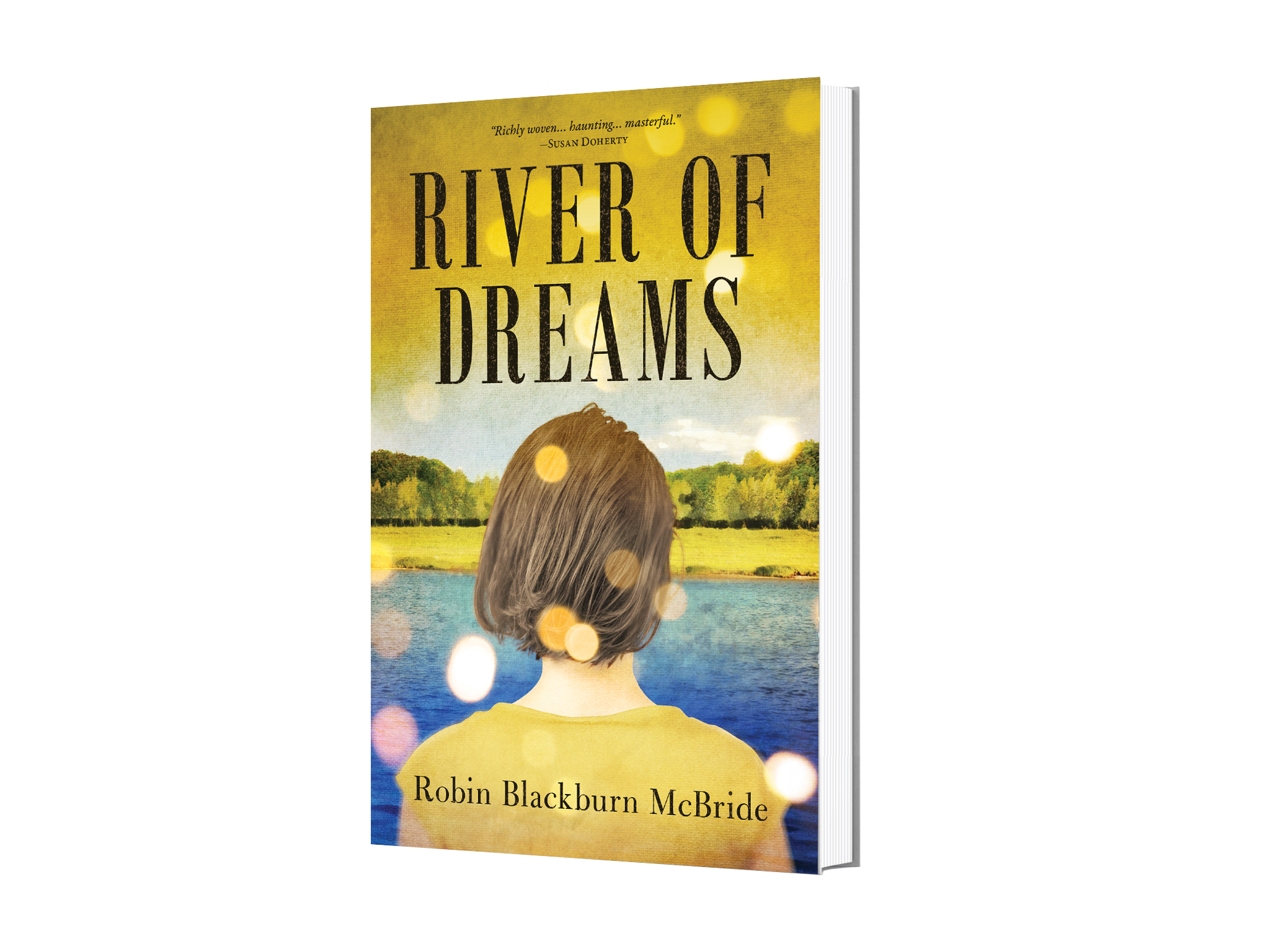
“Caught between her calling and society’s expectations… A haunting exploration of the fine line between genius and madness, and the courage it takes to embrace the extraordinary…”
—Susan Doherty, award-winning author of The Ghost Garden and Monday Rent Boy
River of Dreams is now available for pre-order. Books need early supporters. The novel will be released on October 1st, but pre-orders do a lot to help increase a new book’s visibility. I hope you’ll consider supporting this work by pre-ordering your copy.
Quote of the Week:
“In the Gaelic tradition, the second sight is called do shealladh or ‘two seeings’ and the Hawaiians call it papalua, ‘double vision’ or ‘double knowledge’. The physical and subtle realities are seen at the same time. Fortunately, most of us do not possess this ability in ordinary life, for the involuntary stimulation of the second sight is a terrible affliction as well as a great gift.”
—Caitlín Matthews, Singing the Soul Back Home

Wow! Your rich exploration of the "Seer" through history, memoir and personal story felt like an invitation to remember those parts of ourselves that have always listened beyond the visible world. I loved the way you wove scholarship, childhood wonder and cultural lineage into something both grounded and mysterious.
Re films, one I really enjoyed in the science fiction genre was "Inception" (2010) starring Leonardo DiCaprio. It's all about "dreams." Here's the Wikipedia link: https://en.wikipedia.org/wiki/Inception
Thank you so much Robin for opening a sacred doorway into these deeper conversations. 🙏💖✨
Thank you for sharing such a heartfelt and nuanced reflection on the complexities of psychic phenomena and our intuitive experiences. I appreciate how you honor both skepticism and openness, inviting us to explore these mysteries without judgment. Your personal stories and literary insights beautifully illustrate the delicate dance between belief and doubt. I’m especially moved by your emphasis on connection and the human need for “outside witnesses” to better understand ourselves.