
Reading Soul
What Our Long-ago Loves Can Show Us

Dear Fellow Dreamer,
Recently I was listening to the Write-minded podcast and an interview with Pulitzer award-winning novelist Jayne Anne Phillips. In her conversation with hosts Brooke Warner and Grant Faulkner, Phillips talked about the importance not only of reading, but of finding “reading allies”—those authors we return to again and again, because their creations so deeply resonate.

For writers, reading fine work is as essential to practising and developing our craft as writing itself. But for all of us, no matter our walk of life, reading holds keys to making essential connections—with others, yes. Of course. And also, within ourselves.
That podcast episode sparked my desire to compile a list of contemporary authors whose works compel me and help me to grow. The subject for another letter.
But Phillips’ comments also got me thinking about the books I loved in childhood and youth—those early reading adventures filled with love and wonder.
Was it that way with you? Do you remember the books that others read to you as a little child? Can you recall the first pages you ever read on your own? Did a book—maybe many of them—fill you with awe?
With those questions in mind, I began pulling old loves with tattered dust jackets and furrowed spines from my basement shelves, wondering what my early reading may have yet to say to me.
What can the books you loved in childhood tell you about who you are now?
Some Thoughts on Our Inner Compass
I believe good stories and poems are guideposts for connecting with soul. I also believe that a sense of connection with soul is vital to our growth, and to healing and helping our world.
As a coach, I’ve learned that the process of transforming any area of one’s life begins with identifying core values—those principles and states of being we intuitively hold most dear. Once we’ve recognized those unique underpinnings, we can see the extent to which the life we’ve built, and the dreams we hope to build, line up. When bringing a vision into form, it’s important to be sure that what we’re aiming to create actually aligns with what’s most important to us. If not, then either consciously or unconsciously, we experience inner push-back. Things become wobbly.
Recently, while reading Beth Kempton’s The Way of the Fearless Writer, I came upon an idea central to my own core beliefs: “There is an old Japanese proverb that … means ‘A person’s character at three years old is their character at one hundred.’” For years, I’ve subscribed to that notion. To Jungian author James Hillman’s view that the “oak tree” of our character is both present and visible in the “acorn” state of our childhood. As in Kempton’s Japanese proverb, in his book The Soul’s Code, Hillman argues that clues to our character and calling have been with us since our earliest days.


A good way to discover and connect with your essential values is to see where you started from—what stories you were drawn to and fascinated by as a child.
Here’s a short contemplation on how my childhood reading still points to things I care about. I hope you’ll use these personal examples as jumping-off points for reflecting on your own long-ago book loves, and on what those old stories and poems may have yet to show you.
Early Adventures in Character
Nursery rhymes with their music were part of my life from the start. I recited them each night with my mother.
When I was small, my paternal grandparents owned a bookstore, and the first books I ever owned were mostly from that little shop. I remember riding with Gramma and Grampa on the bus from Stratford, Ontario, where they lived, to the nearby city of Kitchener and a place called Blackburn Books. We ate sandwiches in the damp, dark basement and came up into the light of many shelves. Reaching, I flipped pages and took the books I wanted. Though I wasn’t old enough for school, part of me knew it wasn’t right to just take things and expect to have them. However, another part of me knew I needed those books. My grandparents always sided with the bibliophile part, letting me keep the one or two extras I chose. Their short-lived business was not a commercial success. But in books, it made my cousin Carole and me rich.


Luciana Roselli’s The Polka Dot Child entranced me with its setting—a place where being ill wasn’t a hindrance, but something that gave a girl access to a bespeckled otherworld of enchantment. Perrault’s Fairy Tales were deliciously horrifying (see my About page for a few illustrations), and I enjoyed scaring my younger brother with the pictures and story-snippets he often begged for and has never forgotten. Children’s Stories of the Bible drew me to images of mystical encounters: angels, Jacob’s ladder, the burning bush, and a chariot of fire. While I found the violent dramas weirdly fascinating, the accounts of angelic visitations and visions stayed with me more palpably, underscoring a sense I felt intuitively as a child—that so much is alive and communicating here, so much is possible, though many people don’t pay attention. Over the years that sense grew, leading me to work with wisdom teachers in various traditions.
While charming and funny (and like so many other books of its day, sexist), Tiptoes the Mischievous Kitten was a Ladybird picture book about more than just an adventurous pet’s destructive romps. For me, the story of a bold and curious young cat—a living symbol of independence—was about freedom: a core value from the start. Can you relate?
My love of freedom sparked episodes of uninhibited creative expression, even when I was scolded for it: drawing with crayons on the walls of my young parents’ apartment, picking flowers for my mother from our landlord’s forbidden garden, cutting off half of my long hair with nail scissors. That same core value was also present in the times when I was praised for expressing my passions: illustrating books my mother scribed for me, learning to read aloud, and standing up in front of my school performing verses in first grade. My teacher, Miss Gorsline, became my mentor and (in my mind and heart) my Beloved. She nurtured creative confidence and freedom.


One of the great achievements of grade one was tackling Harold and the Purple Crayon, a book I’ve thought about over the years. With his crayon, Harold had the ability to create worlds—a room, a house, a city. Reading that story, I knew I was a person who wanted to create worlds.
Charlotte’s Web was the first full-length novel I read independently. Have you read it? Do you remember reading it? The idea that a talking spider could weave something so beautiful and powerful it could save a loved one’s life—well, the magic of that broke me open.


In grades four and five, I consumed series books. Laura Ingalls Wilder’s Little House series and Lucy Maud Montgomery’s Anne books ignited the urge to act out those stories with my friends. At recess, on the big field beside our school, we’d organize ourselves into roles and re-enact whole scenes. Privately, my bookish friend Angela and I performed only Anne scenes—mostly exchanges between Anne Shirley and Gilbert Blythe, though sometimes Diana Barrie showed up in Angela’s backyard. Those social reading experiences pointed me to theatre and the value of communicating through live performance—key elements in my life, not only during my early-adult acting years, but in my work as a teacher and coach.


Zilpha Keatley Snyder’s novel, The Egypt Game, with its moody, mysterious illustrations by Alton Raible, stirred a sense of wonder. I read every Snyder novel in our school library, loving how the author presented subjects such as reincarnation, art and rituals, and ancient gods and goddesses. Reading Snyder’s stories, I sensed the importance of keeping an open mind about the nature of reality and what’s possible—a sense that remained alive and awake into early adulthood, including that first summer on my own at nineteen, wandering into Book City in Toronto’s Annex, sipping coffee, browsing the occult shelf, and turning pages in Jane Roberts’ Seth books. In those days, many metaphysical books and works on transformation were labelled “occult.”
By sixth grade, I was immersed in the ghostly, gothic atmospheres of Daphne du Maurier. I fell so in love with the novel Rebecca, that I wrote to its author and she wrote me back. (You can read her letter here.) When, on his way to the Middle East in 1977, my father visited Cornwall, I begged him to bring me something from that magical place. He brought me a Celtic cross that had been made by a woman selling her creations on the beach. Holding the little pendant with its polished, red stone inside a circle, I imagined an old, wise woman whose church was the beach and the rocks.


Elizabeth George Speare’s The Witch of Blackbird Pond was a formative novel. I read a borrowed copy from the library, and decades later, in my late forties, bought myself a paperback edition on a trip with my husband to New England. Speare’s book spoke to me of how important it is for people to have the freedom to be fully who we are—a theme in my own books, and in my life-coaching practice. The Witch of Blackbird Pond showed me women who are wise and have the power to heal.
Seventh grade brought changing bodies and doomed love stories, beginning with Emily Brontë’s Wuthering Heights. Shortly after making that compulsive journey in shivers with Heathcliff and Cathy, I fell into an obsession over F. Scott Fitzgerald. My mother was teaching The Great Gatsby at her high school around the time Eric Carmen released his Gatsby-inspired album, Boats Against the Current—one that spun repeatedly on my red plastic record player. I saw the movie with Robert Redford and Mia Farrow and felt a ghostly pull to Fitzgerald, his novels, his marriage to Zelda Sayer, and to Zelda, too. From my mother’s shelf I pulled Nancy Mitford’s biography of Zelda and read long swaths. From the Humber Bay Library, I ordered other works by Fitzgerald—This Side of Paradise (his debut), short stories, Tender is the Night. I ordered Zelda’s autobiography, Save Me the Waltz, and the memoir by F. Scott’s lover, Sheila Graham, Beloved Infidel. All of that was happening as I did my best to get through our seventh-grade assigned novel, The Yearling, a Pulitzer-winning classic of which I have almost no memory.
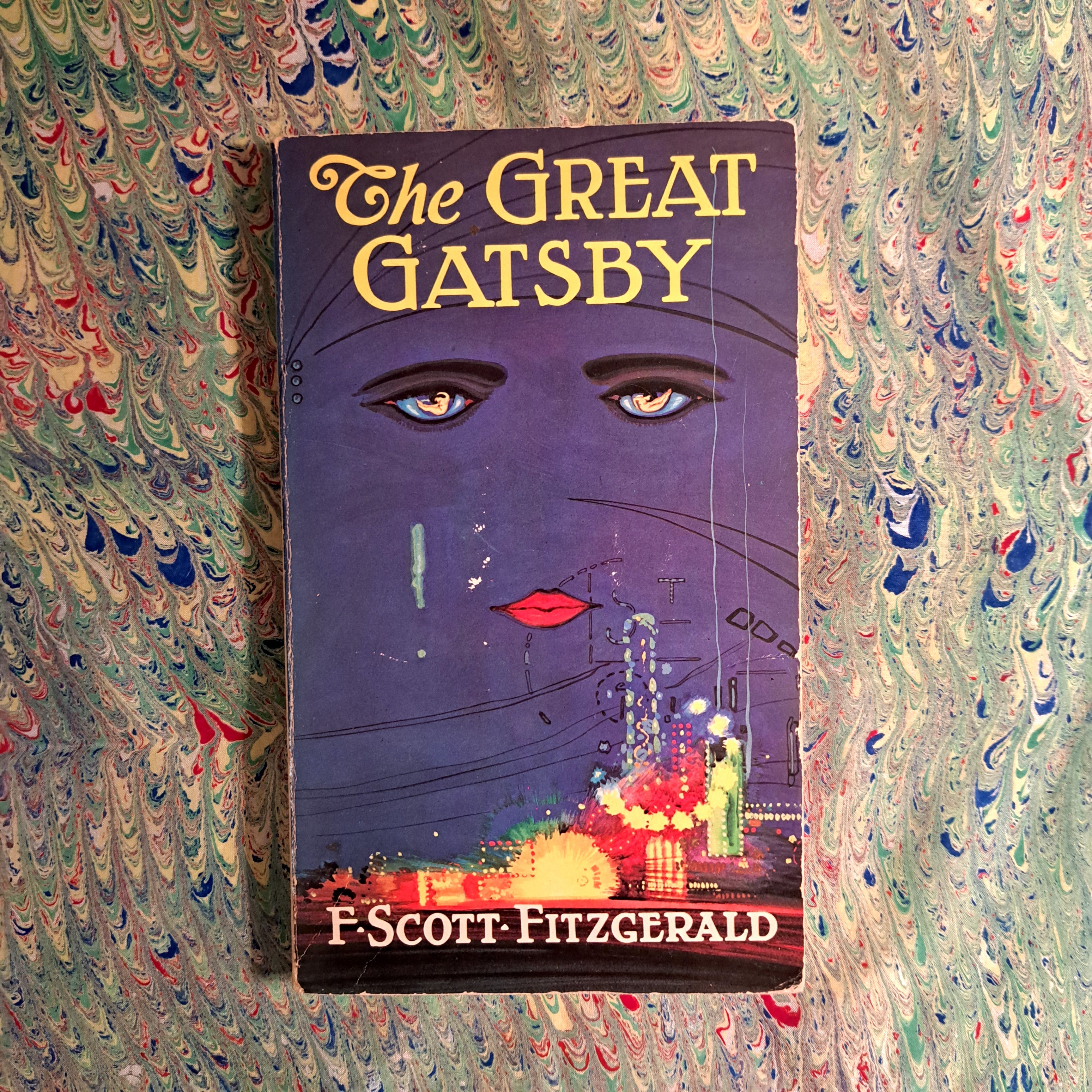
At twelve, I couldn’t fully comprehend Fitzgerald’s work and world, but I knew I loved his writing. In many ways, The Great Gatsby is a perfect novel. Decades later I’d teach it to my own English students, doing my best to help them recognize the exquisiteness of the prose, not just the allure of a story about class conflict, lies, and forbidden love.
Shadows
It would take me years to understand how the novels we adore in youth not only point us to our own values, but sometimes also to our hidden and not-so-hidden inner barriers.
Fitzgerald, an extreme alcoholic, could write like hell. But his ravaged body couldn’t make it past forty-four. Why was the energy of his work such a magnet for an expressive, sensitive, and socially awkward adolescent girl? What was it showing me—not just the precocious twelve-year-old me, but my future self—about my inner trip-wires?
Looking ahead from seventh grade, I couldn’t see my own upcoming adventures in doomed young love. Or that one day, piloting a taxed body, I’d come to face my share of issues with addiction.


The Stone Angel, by Margaret Laurence, was another middle school reading conquest—one that amazed me for different reasons. Before the end of eighth grade, I’d finished it and was partway through Laurence’s The Diviners. Those were not actions that made me popular. But reading those books was essential. I needed to inhabit the stories of Laurence’s bold female protagonists—to feel their self-determination, flaws, and strengths. Unlike Fitzgerald’s Gatsby, Laurence’s main characters were on journeys of growth, ultimately displaying the learning gained through decades of living, often on their own terms. My favourite protagonist, Morag in The Diviners, was a writer.
As I was leaving the public school I’d attended for eight years, my language arts teacher and mentor, Mr. Armstrong, handed me another book—Margaret Atwood’s poetry collection, The Journals of Susanna Moodie, which he’d inscribed. I remember my eyes widening as I took in her work, in particular the poem, “Death of a Young Son By Drowning.” That collection gripped me, showing me how a writer—a poet—could travel back through time and tell the story of someone who’d lived through strange and haunting things—who felt the effects of those things—not only long ago, but by the magic of reading, now.
I needed to travel and tell stories.
A Suggested Exercise
Who were you as a child? What was the oak tree inside the acorn of you?
Discovering and affirming your most essential values is an important step in creating a vision that aligns with what you care about most. This exercise is not about being an avid reader, but simply learning about yourself. So, I invite you to set aside a few minutes and be playful. Curious.
Write down all the books you remember being drawn to as a child. If you remember loving certain picture books and novels, but can’t remember their details, try Googling them to find summaries and make the journey back in time. Maybe you love books now, but struggled to read as a child. Or, perhaps as a kid you were a bookworm, but struggle to finish books now. No matter. Once again, just do your best to remember any stories that stood out for you.
Were there writers whose biographies you admired, though you couldn’t fully enter and appreciate their worlds? (Tolkien is one of those writers for me. And until I grew up, so was Robert Louis Stevenson.) What were the books you yearned to read, while struggling through the assigned texts at school? Simply get curious about the patterns you notice. Do you recognize any core values?
After reflecting and making notes, go ahead and write as many values you can think of based on the kind of reading you loved (or didn’t love) as a child—the ideas and states of being you most cherished. Which ones endure?
Once you’ve generated a longlist of values (without limits), see if you can narrow it to a shortlist.
Can you identify your FIVE most important values? Five is a golden number, since we can easily remember five things, but may struggle to recall ten, twelve, or twenty of anything.
Does the current life you’re living line up with those core values? Are you building a dream? And if so, does it line up?
Coming Soon
In coaching highly creative individuals, I love facilitating the process of discovering those inner foundations unique to each of us—the ones to build upon. For paid subscribers to Awakening Wonder, very soon I’ll be creating a recorded session on identifying your top five core values—a task that’s not always easy, and one I initially found daunting. Working with a system and an experienced guide can really help. Look for more information in my next post.

Quote of the week:
“Don't judge each day by the harvest you reap but by the seeds that you plant.”
—Anon.
This was such a lovely read - many personal favorites as well as titles that are new to me. I agree that the books we read not only shape our beliefs and therefore our lives, but also that they mirror who we are at our core. I believe that we are drawn to certain books and that certain books find us in just the right moment ... not so much in a "fated to meet" kind of way, but more in a "these are breadcrumbs to follow in the labyrinth of your soul" kind of way. It comforts me to know that there are still people out there who find reading to be a lifelong practice that is full of joy and discovery.
Love this line of yours: "I believe good stories and poems are guideposts for connecting with soul." I think that way, too. Especially when I read certain authors. (Claire Keegan is one of them!) For poems, it's many, but if you are not familiar with John Muro, I would suggest searching him out. (I also get really emotional reading Dylan Thomas. Visiting Laugharne and his writer shed a year ago had me crying.)